
Quick Answer:
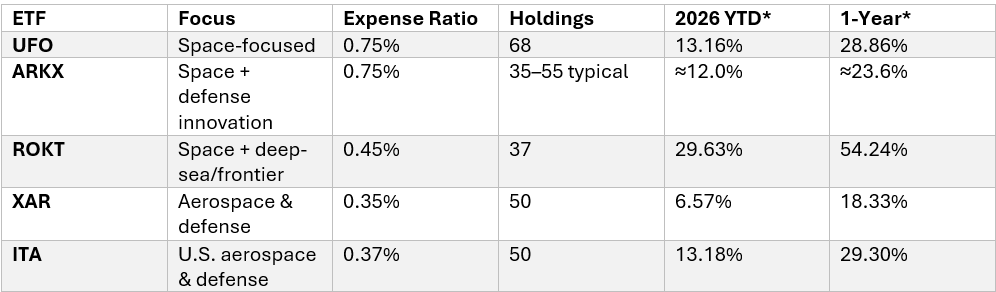
The best space ETF for you depends on how directly you want to invest in the space economy. UFO is one of the most direct space-focused choices, while ARKX combines space with defense and other innovation themes. ROKT adds a broader frontier-technology angle that includes deep-sea exploration. XAR and ITA are better understood as aerospace-and-defense ETFs rather than pure space funds.
For investors comparing these funds, the most important differences are not simply recent performance. Expense ratios, portfolio construction, concentration, exposure to private companies, defense exposure, and the extent to which a fund actually depends on the commercial space economy can materially change the risk profile.
1. UFO: Procure Space ETF
UFO is one of the clearest choices for investors specifically looking for a space-themed ETF. The fund tracks the VettaFi Space Index and is designed to provide exposure to companies participating in the space economy. That makes it particularly relevant for investors who want a thematic allocation rather than a broad aerospace-and-defense portfolio.
Fees and fund profile
UFO had an expense ratio of 0.75% as of the latest fund data used for this article. The ETF launched on April 11, 2019, trades on Nasdaq, and had 68 holdings. Net assets were approximately $549.9 million as of September 24, 2026.
Top holdings
As of September 25, 2026, the largest positions included Space Exploration Technologies Corp. (SpaceX) at 14.60%, Rocket Lab at 5.56%, Garmin at 5.07%, AST SpaceMobile at 4.77%, Trimble at 4.75%, Viasat at 4.65%, EchoStar at 4.60%, Sirius XM at 4.31%, Planet Labs at 3.50%, and MDA Space at 3.30%.
Performance
Through August 31, 2026, UFO’s NAV total return was 13.16% year to date and 28.86% over one year. The market-value returns were 12.99% year to date and 29.16% over one year.
Who is UFO best for?
UFO is most appropriate for an investor who wants relatively direct exposure to the commercial space theme and accepts that a thematic ETF can be more concentrated and volatile than a broad-market index fund.

2. ARKX: ARK Space & Defense Innovation ETF
ARKX is an actively managed ETF and is broader than its original space-only branding might suggest. Effective November 23, 2025, its name changed from ARK Space Exploration & Innovation ETF to ARK Space & Defense Innovation ETF, and its mandate was revised so that at least 80% of assets are invested in equity securities of companies engaged in space and defense innovation.
Fees and fund profile
ARKX had an expense ratio of 0.75%. ARK describes a typical portfolio of approximately 35 to 55 holdings. Net assets were about $759.5 million as of July 31, 2026.
Top holdings
As of September 4, 2026, notable holdings included SpaceX at 10.60%, L3Harris at 6.70%, Kratos at 6.07%, Deere at 5.70%, Rocket Lab at 5.08%, Amazon at 4.59%, NVIDIA at 4.46%, AeroVironment at 4.22%, Alphabet at 3.91%, and AMD at 3.88%.
Performance
For a comparable August 31, 2026 snapshot, ARKX was approximately 12.0% higher on a NAV year-to-date basis and approximately 23.6% higher over one year. ARKX’s results can differ materially from a pure space ETF because its portfolio includes defense, technology, industrial and other innovation exposures.
Who is ARKX best for?
ARKX may suit investors who want space exposure but also want a portfolio built around innovation and defense rather than a narrowly defined space-economy basket.

3. ROKT: SPDR S&P Kensho Final Frontiers ETF
ROKT is often included in space-ETF discussions, but it is important to understand what the fund actually owns. The ETF combines exposure to outer-space technologies with deep-sea exploration and other frontier industries. It therefore should not be treated as a pure-play space fund.
Fees and fund profile
ROKT had an expense ratio of 0.45% and an inception date of October 22, 2018. The fund held 37 securities as of October 2, 2026.
Top holdings
As of October 2, 2026, notable holdings included Forum Energy Technologies at 4.53%, Ducommun at 3.93%, Oceaneering at 3.89%, Iridium at 3.71%, RTX at 3.59%, Moog at 3.55%, Teledyne at 3.54%, Lockheed Martin at 3.33%, Hexcel at 3.26%, and HEICO at 3.25%.
Performance
Through August 31, 2026, ROKT returned 29.63% on a NAV year-to-date basis and 54.24% over one year. Its three-year annualized return was 38.27%, while its five-year annualized return was 22.48%.
Who is ROKT best for?
ROKT is better suited to investors who like the broader frontier-technology concept and do not require a portfolio to be exclusively tied to space.

4. XAR: SPDR S&P Aerospace & Defense ETF
XAR is not a dedicated space ETF. It is an aerospace-and-defense ETF that can provide indirect exposure to companies participating in the space economy. Its modified equal-weight approach gives investors exposure across large-, mid- and small-cap companies in the aerospace and defense industry.
Fees and fund profile
XAR had an expense ratio of 0.35%, an inception date of September 28, 2011, and 50 holdings as of September 22, 2026.
Top holdings
Its leading positions included Rocket Lab at 3.29%, Honeywell Aerospace at 3.18%, AeroVironment at 3.14%, FTAI Aviation at 2.95%, Kratos at 2.90%, Moog at 2.88%, Lockheed Martin at 2.87%, Northrop Grumman at 2.85%, TransDigm at 2.85%, and HEICO at 2.84%.
Performance
Through August 31, 2026, XAR returned 6.57% year to date and 18.33% over one year. Its three-year annualized return was 28.79%, and its five-year annualized return was 16.51%.
Who is XAR best for?
XAR may be a better fit for investors who want aerospace and defense exposure with a lower expense ratio and broader industry diversification than a narrowly focused space ETF.

5. ITA: iShares U.S. Aerospace & Defense ETF
ITA is another broad aerospace-and-defense ETF rather than a pure space fund. Its portfolio is heavily exposed to major U.S. aerospace and defense companies, making it useful as a comparison point for investors deciding whether they want space-specific or industry-wide exposure.
Fees and fund profile
ITA had an expense ratio of 0.37%, launched on May 1, 2006, and held 50 securities as of October 2, 2026.
Top holdings
As of October 2, 2026, major holdings included GE Aerospace at 20.73%, RTX at 16.06%, Boeing at 7.77%, Howmet Aerospace at 4.70%, TransDigm at 4.58%, Lockheed Martin at 4.55%, General Dynamics at 4.42%, and Northrop Grumman at 4.38%.
Performance
Through August 31, 2026, ITA returned 13.18% year to date and 29.30% over one year. Its three-year cumulative total return was 112.44%, its five-year cumulative return was 130.52%, and its ten-year cumulative return was 329.29%.
Because performance can move substantially in a short period, these figures should always be labeled with their measurement date. For example, reported year-to-date NAV performance had changed materially by October 1, 2026.
Who is ITA best for?
ITA is a better fit for an investor who wants broad U.S. aerospace-and-defense exposure and is less concerned about owning companies specifically tied to commercial space.

How Do These ETFs Compare?
There is no single best space ETF for every investor. The key question is what you mean by ‘space exposure.’ UFO is the most straightforward thematic choice in this group. ARKX adds active management and a broader innovation-and-defense mandate. ROKT is a frontier-technology fund that includes deep-sea exposure. XAR and ITA are broader aerospace-and-defense funds.
Expense ratios also matter. XAR is the cheapest of the five at 0.35%, followed by ITA at 0.37%, ROKT at 0.45%, and UFO and ARKX at 0.75%. A higher expense ratio is not automatically a reason to reject a fund, but the investor should understand what additional exposure or portfolio construction they are receiving in return.

Do Space ETFs Own SpaceX?
This is one of the most important distinctions for investors researching space ETFs. Some funds can hold private companies such as SpaceX through eligible investment structures, while others cannot or do not. UFO and ARKX both had direct SpaceX exposure in the holdings data used for this article, with UFO at 14.60% and ARKX at 10.60% as of the respective September 2026 reporting dates.
Investors should not assume that every ETF described as a ‘space ETF’ owns SpaceX. Always check the latest holdings file from the fund issuer before investing.
You can read here how to buy Space X Stocks https://orbitinvestor.com/2026/10/05/howtobuyspacex/
Space ETFs vs. Individual Space Stocks
Buying individual space stocks can provide much more concentrated exposure to a particular company, technology or business model. That concentration can create larger gains when a company executes well, but it can also create substantially larger losses when a company misses expectations.
An ETF spreads company-specific risk across a basket of holdings. The trade-off is that an ETF may dilute the impact of a single successful company, and some holdings may have only a limited relationship with commercial space.
For a long-term investor building a diversified portfolio, the more useful question is often not ‘Which space stock will win?’ but ‘How much thematic exposure, if any, belongs alongside my core portfolio?’

Space ETFs vs. the S&P 500
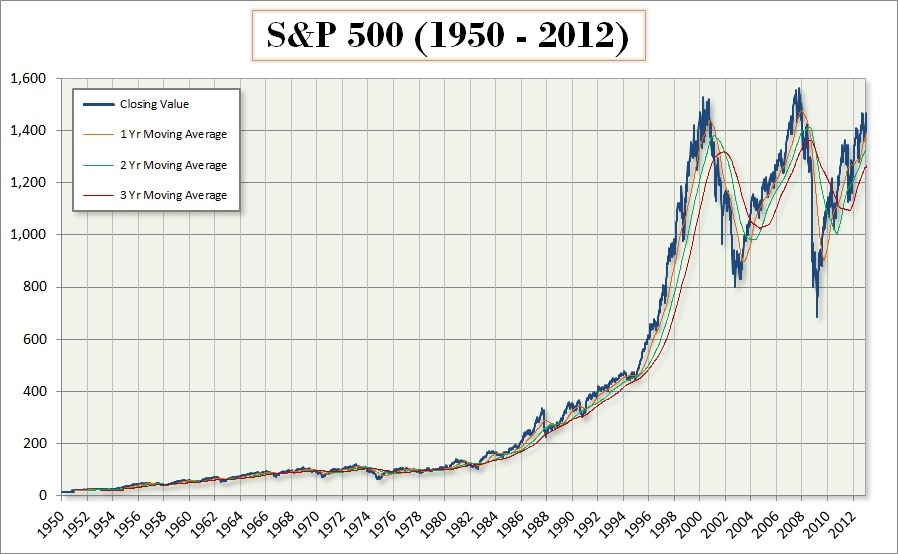
The S&P 500 remains a fundamentally different investment from a thematic space ETF. It provides exposure to approximately 500 leading U.S. companies across many industries, whereas a space or aerospace ETF deliberately concentrates on a narrower theme.
As of August 31, 2026, the S&P 500 had a 12.28% year-to-date price return and an 18.98% one-year price return. These figures are useful as a benchmark, but they should not be compared with an ETF’s total return without checking that the measurement conventions are consistent.
For many investors, a thematic ETF can therefore make more sense as a satellite allocation around a diversified core portfolio rather than as a replacement for broad-market exposure.
Key Risks to Consider Before Buying a Space ETF
Concentration risk: Thematic funds can be much more concentrated than broad-market ETFs. A few holdings or industries may have an outsized effect on results.
Valuation risk: Excitement around space, AI, defense or other innovation themes can push valuations higher than underlying business fundamentals justify.
Volatility: Space-related companies can be sensitive to contract wins, launch outcomes, financing conditions, regulation and changing investor sentiment.
Private-company exposure: An ETF holding a private company may value that position differently from a publicly traded security, and the exposure can change over time.
Theme drift: Some funds marketed in space-investing discussions also own defense, industrial, technology or deep-sea companies.
No guarantee of future returns: Strong historical performance does not establish that an ETF will outperform in the future.
How We Evaluated These ETFs
This comparison uses five criteria: thematic relevance, expense ratio, portfolio construction, holdings and historical performance. Fund facts and holdings were checked against issuer materials where available. Performance figures are labeled by date because ETF returns change continuously.
The purpose of the ranking is educational, not to predict which fund will have the highest return. A lower-cost fund is not automatically better, and the ETF with the strongest recent performance is not automatically the best long-term choice.
Frequently Asked Questions
What is the best space ETF in 2026?
There is no universal best choice. UFO is one of the most direct space-focused options, while ARKX offers a broader space-and-defense innovation approach. ROKT, XAR and ITA provide progressively broader exposure outside pure commercial space.
Which space ETF has the lowest expense ratio?
Among the five ETFs compared here, XAR has the lowest expense ratio at 0.35%, followed by ITA at 0.37%, ROKT at 0.45%, and UFO and ARKX at 0.75%.
Which ETFs own SpaceX?
UFO and ARKX both reported SpaceX exposure in the September 2026 holdings data used for this article. Holdings can change, so investors should verify the latest fund data before investing.
Are space ETFs risky?
They can be. Space ETFs are generally more thematic and concentrated than broad-market index funds, and their holdings can be sensitive to valuation, technology, contracts, regulation and investor sentiment.
Should I replace my S&P 500 ETF with a space ETF?
For most diversified investors, that is not the right way to frame the decision. A space ETF can be considered a satellite allocation around a diversified core, depending on risk tolerance, time horizon and overall portfolio construction.
Primary Sources to Cite on the Published Page
- Procure ETFs — UFO fund page and fund materials.
- ARK Invest — ARKX fund page and portfolio information.
- State Street Global Advisors — ROKT and XAR fund pages.
- iShares / BlackRock — ITA fund page.
- S&P Dow Jones Indices — S&P 500 index facts and performance.
- Google AdSense Help — eligibility and site-readiness guidance.
- Google Search Central — guidance on helpful, reliable, people-first content and E-E-A-T for YMYL topics.