

The best space stocks to buy now are no longer a one-company conversation. SpaceX completed the largest IPO in history on June 12, 2026, trading on Nasdaq as SPCX at $135 per share. That answers the old question, “How do I buy SpaceX stock?”, and raises a new one: which other public companies offer real exposure to the space economy? From my perspective, the retail crowd remains hyper-focused on SpaceX. However, the real strategic play lies in identifying alternatives that quietly lock in multi-year revenue.
Below are ten U.S.-listed companies beyond SpaceX, grouped by risk, with their latest quarterly results, the case for each and the main risks. Here, “best” means “most worth researching,” not “certain to go up.” In my view, investors must approach this sector with caution: several of these companies still lose money, and space stocks can move 10% or more in a single day.
What Changed After the SpaceX IPO
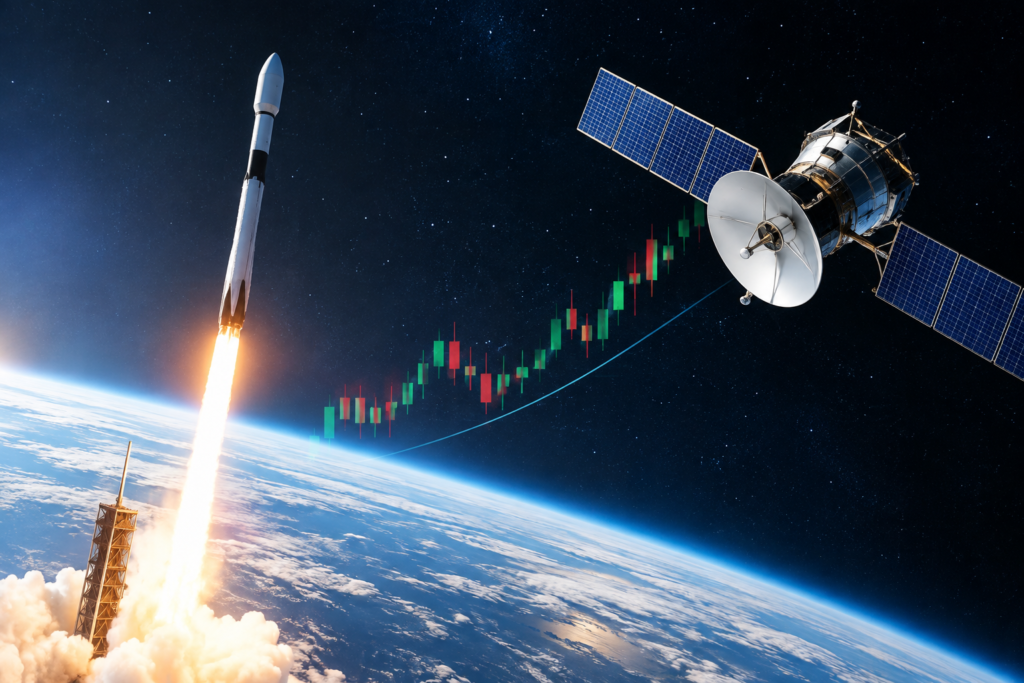
SpaceX priced at about a $1.75 trillion valuation, hit an intraday high near $225 within days of listing, then fell by roughly half by late July. In early October it traded near $148. Other space stocks have swung with that sentiment: they rallied in May and June, then sold off sharply in July. To me, this correction closely mirrors textbook market emotion. It proved that the broader sector still relies heavily on SpaceX as a sentiment proxy. At the same time, rising defense budgets and the Golden Dome missile-defense initiative are sending contracts to a wider group of suppliers. In my view, this is where the macroeconomic thesis for alternative space stocks becomes compelling: federal capital is diversifying, even if retail traders haven’t realized it yet.
How We Selected These Companies
Every company trades on the NYSE or Nasdaq, has real space exposure, and has reported results for its most recent quarter (ended June 30, 2026, or July 31, 2026 for Planet Labs). We left out SpaceX itself and Iridium Communications, which Rocket Lab has agreed to acquire. We also left out share prices, because they change constantly. In my analysis, focusing on real-time tickers causes investors to miss the bigger picture; fundamentals matter more than daily chart noise. Backlog, meaning contracted work not yet delivered, is a useful gauge of demand but I must emphasize that it is not guaranteed revenue. The U.S. space sector relies heavily on federal budget approvals. Therefore, a massive backlog is a strong signal, but execution remains the ultimate risk.
The 10 Space Stocks at a Glance
| Company (Exchange: Ticker) | What it does | Latest reported quarter | Risk level |
| Lockheed Martin (NYSE: LMT) | Defense prime; Orion spacecraft, missile-defense interceptors, ULA launch joint venture | Q2 2026 revenue $20.1B (+10.5%); record backlog $230.4B | Lower |
| Northrop Grumman (NYSE: NOC) | Defense prime; satellites, solid rocket motors, Cygnus cargo spacecraft | Q2 2026 sales $10.9B (+5%); record backlog about $105B | Lower |
| L3Harris (NYSE: LHX) | Defense and space electronics, sensors, rocket propulsion | Q2 2026 revenue up 8%; record backlog $42B | Lower |
| Rocket Lab (Nasdaq: RKLB) | Electron launches, spacecraft manufacturing, Neutron rocket in development | Q2 2026 revenue $234.1M (+62%); backlog $2.36B | Higher |
| Planet Labs (NYSE: PL) | Earth-imaging satellites and data subscriptions | Q2 fiscal 2027 revenue $116.1M (+58%); backlog $814.9M | Higher |
| Intuitive Machines (Nasdaq: LUNR) | Lunar landers, spacecraft manufacturing, space data services | Q2 2026 revenue $206.2M (vs. $50.3M); backlog $1.8B | High |
| Redwire (NYSE: RDW) | Space infrastructure and defense technology | Q2 2026 revenue $117.1M (+89.6%); backlog $542.1M | High |
| Firefly Aerospace (Nasdaq: FLY) | Alpha rocket, Blue Ghost lunar landers, defense software | Q2 2026 revenue $117.7M (+659%); backlog $1.5B | High |
| Voyager Technologies (NYSE: VOYG) | Defense technology, Starlab commercial space station, Astrobotic | Q2 2026 revenue $52.7M; backlog $335.5M | High |
| AST SpaceMobile (Nasdaq: ASTS) | Satellites that connect directly to ordinary smartphones | Q2 2026 revenue $31.5M (missed estimates); backlog about $1.3B | Very high |
Risk labels are editorial judgments relative to the other companies on this list. Even a “Lower” label means you can lose money.

Established Anchors: Defense and Space Contractors
1. Lockheed Martin (NYSE: LMT)
Lockheed Martin is the largest U.S. defense contractor. Its Space segment builds NASA’s Orion capsule, the Next Generation Interceptor and classified satellites, and the company co-owns launch provider United Launch Alliance. In the second quarter of 2026, revenue rose 10.5% to $20.06 billion, earnings of $7.94 per share beat the $7.20 estimate, and backlog hit a record $230.4 billion. Full-year earnings guidance was raised to $29.95 to $30.65 per share.
The case: In my analysis, Lockheed remains a rock-solid safe haven because it is profitable and pays a dividend, and the Space Force chose it to build space-based interceptor prototypes for Golden Dome (proving that federal backing is their ultimate moat).
The risks: Investors must keep in mind that space is the slower part of the business (segment profit rose just 2%), a Vulcan launch failure reduced earnings from the ULA joint venture, and from my perspective, ongoing program charges have caused earnings misses before.
2. Northrop Grumman (NYSE: NOC)
Northrop builds the B-21 bomber and the Sentinel missile, and its Space Systems segment makes satellites, solid rocket motors and the Cygnus cargo spacecraft that resupplies the International Space Station. Second-quarter sales rose 5% to $10.9 billion, earnings were $7.68 per share versus about $6.84 expected, and $20 billion of net awards lifted backlog to a record of about $105 billion. Sales guidance for 2026 was raised to $43.75 billion to $44.25 billion.
The case: In my view, the thesis for NOC is heavily reinforced by an enormous backlog, national security space as a stated growth priority, and a dividend that appeals to long-term investors.
The risks: cost overruns on the SiAW missile and the GEM 63XL rocket motor hurt margins, Space Systems margin is now guided to the low 10% range, and from my perspective, the most critical risk is that management’s guidance assumes no prolonged government shutdown in Washington.
3. L3Harris Technologies (NYSE: LHX)
L3Harris supplies satellites, sensors and, through Aerojet Rocketdyne, rocket engines and solid rocket motors. Second-quarter revenue rose 8%, orders reached $7.3 billion (a book-to-bill ratio of 1.2), backlog hit a record $42 billion, and free cash flow grew 37% to $771 million. The company raised its 2026 revenue and earnings guidance.
The case: strong cash generation and unparalleled exposure to missile warning, tracking and propulsion, plus a defensive dividend. The key asset here is Aerojet Rocketdyne, which fundamentally secures their position in the Pentagon’s supply chain.
The risks: Space & Mission Systems margin fell to 9.8% because a prior-year gain did not repeat, and this margin drop highlights why execution matters. Additionally, the planned sale of its commercial space propulsion business should reduce 2026 earnings by roughly $0.20 per share.
Scaled Growth Leaders
4. Rocket Lab (Nasdaq: RKLB)
Rocket Lab launches satellites on its Electron rocket, flies hypersonic tests, builds spacecraft and components, and is developing the larger Neutron rocket. It is the closest public rival to SpaceX’s integrated model. Second-quarter revenue rose 62% to $234.1 million, backlog hit a record $2.36 billion (up 137%), and third-quarter revenue is guided to $250 million to $265 million.
The case: This is arguably the most viable pure-play option for retail capital right now because revenue is spread across launch and space systems, and the $8 billion Iridium acquisition ($54 per share in cash and stock, approved by Iridium holders in September, closing expected mid-2027) would add highly lucrative recurring revenue to their balance sheet.
The risks: Neutron has not flown and the CEO says the year-end window is narrowing which signals potential timeline friction. The company still reports a GAAP net loss, and it sold $1.53 billion of shares in the first half and $1.94 billion in September, a heavy capital raise that severely dilutes existing holders.
5. Planet Labs (NYSE: PL)
Planet operates one of the largest Earth-imaging satellite fleets and sells data subscriptions, with 98% of annual contract value recurring. In the quarter ended July 31, 2026, revenue rose 58% to a record $116.1 million, adjusted EBITDA was a $13.9 million profit, the net loss narrowed to $9.4 million, and backlog stood at $814.9 million. Cash and short-term investments totaled $865.4 million.
The case: This SaaS-like model means subscriptions give steadier revenue than launch hardware, the company is close to breakeven, and its cash cushion is large enough to remove short-term bankruptcy risk.
The risks: third-quarter revenue guidance of $101 million to $105 million came in below the roughly $114.5 million analysts expected, which shows revenue can be uneven, and growth leans heavily on government contracts and bureaucratic defense procurement cycles.

Emerging and Higher-Risk Names
6. Intuitive Machines (Nasdaq: LUNR)
Intuitive Machines builds lunar landers for NASA and has expanded into spacecraft manufacturing and space data services through acquisitions. Second-quarter revenue was $206.2 million, over four times a year earlier but short of estimates. The net loss was $62.8 million, and backlog reached a record $1.8 billion after $920 million of new awards. Management still targets about $1 billion of revenue in 2026.
The case: The long-term bull thesis is strengthening as revenue now spans civil, commercial and national security customers, including a July award for 18 Golden Dome spacecraft that validates their military expansion.
The risks: The primary concern here is their cash burn rate; cash fell from $582.6 million at the end of 2025 to $367.4 million, operations used $59.8 million in the quarter, lunar missions can fail on a single landing, and unquestionably, the acquisitions add near-term integration risk.
7. Redwire (NYSE: RDW)
Redwire builds space infrastructure and has expanded into defense technology such as drones and surveillance payloads. Second-quarter revenue jumped 89.6% to $117.1 million, gross margin turned positive at 27.8%, the net loss was $41.0 million, and backlog hit a record $542.1 million. Management reaffirmed 2026 revenue guidance of $450 million to $500 million.
The case: This company is executing a massive turnaround, evidenced by Defense Tech revenue grew to $61.9 million from $5.1 million a year earlier, and total debt fell 75% to $48.9 million which significantly de-risks their balance sheet.
The risks: Space segment revenue slipped 2.6%, the execution bar for the rest of the year remains exceptionally high: reaching the guidance midpoint requires about $261 million in the second half, roughly 22% more than the first half, leaving very little room for operational delays.
8. Firefly Aerospace (Nasdaq: FLY)
Firefly builds the Alpha rocket, is developing the larger Eclipse vehicle, and operates Blue Ghost lunar landers and defense software. Second-quarter revenue was a record $117.7 million, up 659%, backlog reached $1.5 billion, the net loss was $92.3 million, and free cash flow was negative $106.3 million. Guidance of $420 million to $450 million for 2026 was maintained.
The case: Lockheed Martin extended its agreement for up to 25 Alpha launches through 2031, securing a critical anchor customer, and most of the 2027 launch manifest is already sold to commercial buyers.
The risks: the 2026 Alpha launch target was cut from four to three, highlighting execution bottlenecks. Furthermore, launch revenue is recognized only when a launch happens, meaning revenue recognition timing remains highly volatile, and cash burn is heavy.
9. Voyager Technologies (NYSE: VOYG)
Voyager sells technology to defense and national-security customers and owns most of Starlab, a planned commercial space station to succeed the International Space Station. It completed the Astrobotic lunar-lander acquisition in July. Second-quarter revenue was a record $52.7 million, bookings were $113.0 million (a book-to-bill ratio of 2.1), backlog was $335.5 million, and the net loss was $46.5 million. Guidance was raised to $275 million to $305 million.
The case: record bookings and more than $500 million in Starlab commercial reservations which provides excellent forward visibility.
The risks: guidance is back-loaded, so fourth-quarter revenue would need to be more than double the second quarter, creating high execution pressure. Furthermore, Starlab remains a binary play since it earns no revenue yet, and the stock traded between roughly $17 and $52 in the 12 months to early August reflecting severe institutional volatility.
10. AST SpaceMobile (Nasdaq: ASTS)
AST SpaceMobile is building a space-based cellular network whose BlueBird satellites connect directly to ordinary smartphones, with more than 60 carrier partners covering over 3 billion subscribers. Second-quarter revenue was $31.5 million, missing the $34.4 million estimate after a first-quarter miss, and the quarter included a $125.9 million loss tied to the BB7 launch incident. It has 13 satellites in orbit, about $1.3 billion in backlog and more than $3.7 billion in pro forma liquidity.
The case: direct-to-phone coverage could reach billions of users if the technology scales validating their massive Addressable Market (TAM).
The risks: this is the most speculative stock on the list. It is not yet commercial at scale, meaning commercial viability is still unproven. It depends on successful launches, faces SpaceX’s own direct-to-phone ambitions through Starlink—which is a severe headwind— and was down about 20% for the year as of early October, reflecting a major shift in market sentiment.

How to Add Space Stocks to a Portfolio
- Start with a diversified core. Lockheed Martin, Northrop Grumman and L3Harris are long-standing S&P 500 members, so a broad S&P 500 fund already gives you some exposure. Adopting a strict core-satellite approach ensures your baseline wealth isn’t held hostage by orbital volatility.
- Keep theme bets small. A common rule of thumb is to limit speculative themes to a low single-digit share of the portfolio, such as 5% or less. Allocating more than this to unproven space pure-plays crosses the line from strategic investing into pure gambling.
- Do not stack similar risks. Five small, unprofitable space companies behave like one big bet. Mixing tiers spreads the risk and prevents a single operational launch failure from triggering a catastrophic portfolio drawdown.
- Spread out your entry. Buying in installments —often referred to as dollar-cost averaging (DCA)— reduces the damage of a bad entry point, and the filings on the SEC’s EDGAR database are free to read. Utilizing these public corporate disclosures is the most effective tool a self-directed investor has to out-verify the Wall Street hype.
Key Risks of Space Stocks
- Valuation and dilution: many pure plays trade on future promises and fund growth by selling new shares. This reality means that standard valuation metrics often decouple from actual corporate revenues, trapping unsuspecting buyers.
- Launch and technical failures: a single failure can erase value quickly, as the Vulcan and BB7 incidents showed. In this industry, hardware destruction translates instantly into compressed operating margins and severe stock sell-offs.
- Government dependence: defense budgets, NASA funding and shutdowns affect most companies here. Consequently, federal policy pivots in Washington represent an ongoing regulatory risk that investors cannot hedge against.
- Hype cycles: the July sell-off after the SpaceX rally showed how fast enthusiasm reverses. The key takeaway is that sentiment moves faster than fundamentals, making orbital stock prices highly volatile during retail-driven spikes.
Frequently Asked Questions
Can I buy SpaceX stock now?
Yes. SpaceX has traded on Nasdaq under the ticker SPCX since June 12, 2026, and you can buy it through a standard brokerage account. This historic listing finally opened direct retail access to Elon Musk’s aerospace empire, though the stock has been very volatile since its debut.
What is the best space stock for beginners?
There is no single best choice. For those looking for a safer, diversified infrastructure play, beginners often start with larger, profitable companies such as Lockheed Martin, Northrop Grumman or L3Harris, or with a diversified fund, and treat smaller pure plays as small, optional positions.
How much of my portfolio should be in space stocks?
It depends on your goals, time horizon and risk tolerance. From a conservative asset allocation standpoint, a common rule of thumb is 5% or less for speculative themes. A licensed financial professional can help you set a level that fits you and balances your broader risk profile.
Do these space stocks pay dividends?
The three defense contractors do. Faster-growing companies such as Rocket Lab, AST SpaceMobile and Planet Labs have not historically paid regular dividends, reinvesting cash into development instead. Check each company’s latest filings to monitor any changes in capital allocation.
The Bottom Line
The SpaceX IPO put the space economy in the spotlight, but the opportunity does not end with one company. The key takeaway for long-term investors is balance: defense primes offer steadier exposure, Rocket Lab and Planet Labs offer faster growth, and the smaller names offer higher potential with higher risk. Build on a diversified base, keep theme positions small, and revisit your thinking each quarter when new results arrive to ensure your investment thesis remains intact amid changing market conditions.
Disclaimer
This article is for informational and educational purposes only and is not personalized investment, financial, tax or legal advice. Nothing here is a recommendation or solicitation to buy or sell any security. All investing involves risk, including the possible loss of your entire investment, and past performance does not guarantee future results. Figures are as reported by the companies for their most recent quarters and are current as of October 9, 2026. Before making any investment decision, do your own research and consider speaking with a licensed financial professional.
Sources and Data Notes
- SEC EDGAR: Company Investment Database Search
- SEC EDGAR: SpaceX (SPCX) Official Form S-1 Filing
- NASA: Commercial Space Capabilities Information
- Lockheed Martin IR: Official Q2 2026 Financial Performance Reports
- SEC EDGAR: Northrop Grumman (NOC) Q2 2026 Earnings Release
- L3Harris IR: Space & Mission Systems Quarterly Earnings Statement
- SEC EDGAR: Rocket Lab (RKLB) Q2 2026 Financial Disclosure
- Planet Labs IR: Fiscal Year 2027 Q2 Performance Overview
- SEC EDGAR: Intuitive Machines (LUNR) Q2 2026 Form 10-Q
- Redwire IR: Corporate Earnings Releases and Operational Progress Dashboard
- Firefly Aerospace IR: Official Second Quarter 2026 Financial Disclosures
- Voyager Technologies IR: Record Second Quarter 2026 Operational Disclosures
- SEC EDGAR: AST SpaceMobile (ASTS) Q2 2026 Comprehensive Financial Report
Written by L.Gomez · Last updated: October 15, 2026