

Is SpaceX profitable? The short answer is no, at least not on a standard net-income basis. SpaceX has traded on Nasdaq as SPCX since June 12, 2026, and its public filings show a net loss of $4.9 billion in 2025 and a net loss of $541 million in the second quarter of 2026. Yet one part of the business, Starlink, is highly profitable, and the company’s adjusted earnings are positive. Both statements are true at once, and parsing through this accounting paradox is the real key to understanding the stock, especially if you are looking to buy SPCX shares.
This guide breaks down what SpaceX’s prospectus and first earnings report as a public company actually say about revenue, margins and losses, and what we, as investors, should honestly watch next.

The Short Answer
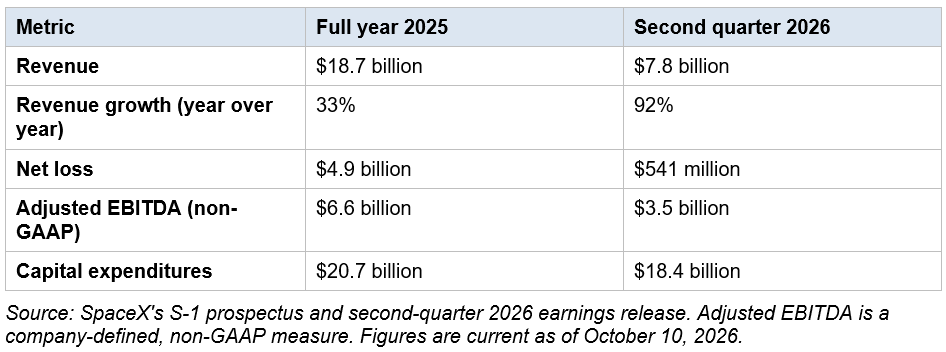
- On a GAAP basis, SpaceX is not profitable. It lost $4.9 billion in 2025 on revenue of $18.7 billion, and it lost $541 million in the second quarter of 2026 on revenue of $7.8 billion.
- Starlink is the profit engine. The Connectivity segment earned $4.4 billion of operating income in 2025, boasting a massive 39% operating margin.
- The losses come from heavy investment. Massive capital expenditures into the AI business and Starship development, along with very large capital spending, outweigh Starlink’s profit.
- The trend is improving. Fortunately for shareholders, the quarterly net loss narrowed from $1.0 billion a year earlier, while revenue grew an impressive 92%.
SpaceX Financials at a Glance
Where SpaceX Makes and Loses Money
SpaceX reports three segments. The 2025 figures from the S-1 prospectus clearly expose a business with one massive profit engine subsidizing two heavy spenders:
- Connectivity (Starlink): $11.4 billion in revenue, about 61% of the total, delivering a staggering $4.4 billion in operating income. As of now, this is the only segment keeping the company’s core operational finances in the green.
- Space (launch and Starship): about $4.0 billion in revenue and an operating loss of $657 million. The segment spent roughly $3 billion on research and development for Starship, the next-generation rocket.
- AI (the former xAI business, acquired in February 2026): $3.2 billion in revenue and an operating loss of $6.4 billion. This is where the heaviest cash burn sits, as it also accounted for $12.7 billion of SpaceX’s $20.7 billion in total capital spending.
Put together, SpaceX reported an operating loss of $2.6 billion for 2025. Starlink’s $4.4 billion profit was more than consumed by the AI segment’s $6.4 billion loss alone, before counting the Space segment. This clearly highlights how much the new AI infrastructure is currently weighing down the company’s overall bottom line.

A Swing From Profit to Loss: 2024 Versus 2025
According to the S-1, SpaceX reported net income of $791 million in 2024, then a net loss of $4.9 billion in 2025, even though revenue grew 33%. The swing coincides with the buildout of the AI business, which SpaceX acquired in February 2026 and which is included pro forma in the reported figures, so year-over-year comparisons should definitely be read with care.
The key point is that growth alone has not produced profit. Costs have grown faster in the segments that are still investing, and management has chosen to keep spending heavily on future capacity instead of slowing down to report a profit. For investors, this confirms that SpaceX is still prioritizing long-term market dominance over near-term earnings reports.
Why Adjusted EBITDA Is Positive but Net Income Is Negative
SpaceX’s adjusted EBITDA was $6.6 billion in 2025, yet its net loss was $4.9 billion. The gap is large because EBITDA excludes costs such as depreciation, interest and certain other items. For a company that spends billions on satellites, rockets and data centers, depreciation is a real and growing expense, and the company also carries debt: its long-term debt was $29.1 billion at the end of March 2026. This massive leverage means interest payments will remain a heavy burden for the foreseeable future.
Adjusted EBITDA is useful for judging underlying operations, but it is a non-GAAP measure that each company defines for itself. Ultimately, net income, which includes all of those costs, remains the stricter test of profitability and it’s the metric cautious investors should anchored their valuations to.
What the Second Quarter of 2026 Showed
SpaceX’s first earnings report as a public company, released on August 4, 2026, showed faster growth and a smaller loss than many anticipated:
- Revenue rose 92% to $7.8 billion, well above the $6.8 billion analysts expected.
- Net loss narrowed to $541 million, or 9 cents per share, versus a loss of about 26 cents per share expected and a $1.0 billion loss a year earlier. This massive beat caught short-sellers completely off guard.
- Adjusted EBITDA reached $3.5 billion, up 191%.
- Connectivity revenue grew 66% to $4.3 billion, and operating income in the segment grew 79%. Starlink reached 12 million subscribers, double the year-earlier level, though average revenue per subscriber was $66, down 22% from a year earlier as lower-priced plans and international growth diluted the average. This drop in ARPU is a vital metric to monitor, as it shows SpaceX is sacrificing pricing power to capture global volume.
- AI turned adjusted-EBITDA positive at $1.1 billion, although the segment still had a net operating loss of about $1.3 billion. The Space segment’s adjusted EBITDA was a loss of $205 million because of higher Starship spending.
- Cash and backlog: SpaceX ended the quarter with a massive fortress of $100 billion in cash, cash equivalents and marketable securities, plus $47.5 billion in backlog, giving them an incredible runway to fund their ongoing capital-intensive projects.
The stock still fell as much as 8% in after-hours trading, because capital expenditures jumped to $18.4 billion in the quarter from $10.1 billion in the prior three months. This post-earnings slide proves that Wall Street is currently more terrified of Elon Musk’s aggressive cash burn than it is impressed by Starlink’s growth.

What the Margins Look Like
Using the reported figures, here is how the margins work out. These percentages are our own calculations, rounded, designed to help cut through the complex corporate reporting:
- Starlink operating margin, 2025: about 39% ($4.4 billion on $11.4 billion). This is an exceptionally healthy figure for any telecommunications infrastructure business.
- Company-wide operating margin, 2025: about negative 14% (a $2.6 billion loss on $18.7 billion).
- Company-wide net margin, 2025: about negative 26%.
- Net margin, second quarter 2026: about negative 7%, marking a clear improvement and signaling that the business is finally moving in the right direction.
What Could Change SpaceX’s Profitability
- Capital spending. At $18.4 billion in a single quarter, this massive infrastructure deployment is the biggest swing factor for reported results.
- The AI segment. Its losses drive the consolidated result. While SpaceX officially closed its mega-acquisition of Cursor for $60 billion in August 2026, integrating this developer platform adds a massive new variable.
- Starship. If reusability brings launch costs down as management expects, the Space segment’s losses could shrink. Until then, development spending continues to act as a near-term drag.
- Starlink pricing and growth. Subscriber growth is strong, but falling revenue per subscriber (ARPU dilution) could slow overall profit growth.
- Government work. Starshield was awarded more than $6 billion in multi-year U.S. government contracts, which provides a highly reliable baseline for revenue.

What This Means for Investors
A loss does not automatically make a stock a bad investment, but it does raise the stakes on execution. At its IPO valuation of roughly $1.75 trillion, SpaceX was priced at about 94 times its 2025 revenue, so investors were paying for years of future growth. The shares have been volatile, trading from a high near $225 to roughly $148 in early October, against an offer price of $135. This volatile price action is a textbook example of high-growth tech investing: when valuation multiples are stretched, any dip in sentiment triggers sharp corrections.
- Look at GAAP and adjusted figures together. Neither alone tells the whole story, and over-indexing on just one can lead to heavily distorted valuations.
- Track cash and capital spending. SpaceX has $100 billion in cash, but spending of this size can change quickly.
- Size your position carefully. An unprofitable, richly valued and volatile stock deserves a smaller allocation than a profitable, established one. In my view, risk management should always trump speculation, especially with high-multiple stocks.
- Read each quarterly report. The next results will show whether the loss keeps narrowing, providing critical feedback on whether their massive infrastructure bets are actually starting to scale.
Frequently Asked Questions
Is SpaceX profitable in 2026?
Not on a net income basis so far. The second-quarter 2026 net loss was $541 million. Some analysts have suggested the company could approach breakeven later in the year, but forecasts are highly uncertain and results depend heavily on capital spending.
Is Starlink profitable?
Yes. The Connectivity segment earned $4.4 billion of operating income on $11.4 billion of revenue in 2025, and its operating income grew an impressive 79% year over year in the second quarter of 2026.
Why does SpaceX lose money if revenue is growing?
Costs are growing as well. SpaceX is spending heavily on AI infrastructure, Starship development and satellites, and those unprecedented costs currently exceed Starlink’s profit.
Why did SpaceX not publish financials before?
Before its IPO, SpaceX was a private company and was not required to disclose detailed results. The S-1 filed in May 2026 gave investors the first complete look at its finances, and as a public company it now reports every quarter.
How much cash does SpaceX have?
SpaceX reported $100 billion in cash, cash equivalents and marketable securities at the end of June 2026, along with $29.1 billion of long-term debt at the end of March 2026. This balance sheet provides a massive runway.
The Bottom Line
SpaceX is a fast-growing company with a very profitable core business and very large investment needs. It is not profitable under GAAP today, but the loss consistently is narrowing and Starlink shows that the business model can earn strong margins. Whether the whole company reaches sustained profit depends mainly on how long it keeps spending at this pace and whether Starship and AI ultimately repay that investment.
Disclaimer
This article is for informational and educational purposes only and is not personalized investment, financial, tax or legal advice. Nothing here is a recommendation or solicitation to buy or sell any security. All investing involves risk, including the possible loss of your entire investment, and past performance does not guarantee future results. Figures come from SpaceX’s public filings and press coverage, are current as of October 10, 2026, and may be revised in later reports. Before making any investment decision, do your own research and consider speaking with a licensed financial professional.
Sources and Data Notes
- U.S. Securities and Exchange Commission: Space Exploration Technologies Corp. Form S-1 Registration Statement
- U.S. Securities and Exchange Commission: SpaceX Second-Quarter 2026 Earnings Release (Form 8-K)
- PitchBook Data: SpaceX Post-Earnings After-Hours Capital Expenditure Assessment
- CNBC Finance: SpaceX (SPCX) Market Intelligence and Corporate Integration Files
- Cursor Blog: Cursor is now a part of SpaceX
- MarketWatch Financial Analytics: SpaceX’s Starshield Satellites Procurement Tracking & Military Contracts Data
- SpaceX Investor Relations: Official IPO Pricing Announcement and Capital Allocation Updates
Written by L.Gomez · Last updated: October 15, 2026