
Exactly one year ago, on October 7, 2025, I bought my first S&P 500 index fund. I didn’t try to time the market or decode messy candlestick charts. I ignored the hyped tech stocks and chose a simple, admittedly boring plan: invest on a regular schedule and leave it alone. In a world obsessed with overnight millionaires, my strategy felt almost too quiet. If you want to understand the exact regulatory hurdles and how these choices trigger massive buying waves on Wall Street, check out my deep dive on how companies get added to the S&P 500.
One year later, I checked my portfolio with a mix of curiosity and nerves. In this article, I share my exact numbers and every contribution. This includes the messy reality of the months I skipped due to unexpected real-life expenses. I will also reveal my broker and specific fund.
More importantly, I will break down what that 17.16% return actually means. Along the way, I explain how the S&P 500 and dollar-cost averaging (DCA) work. My goal is to give you a practical framework for your own financial journey, whether you invest like me or not.
What Is the S&P 500?
The S&P 500 is a stock market index that follows 500 of the largest publicly traded companies in the United States, acting as the definitive gravity well for institutional capital. It is maintained by S&P Dow Jones Indices, and companies are selected according to published rules that consider factors such as size, liquidity, profitability, and U.S. domicile.
An index is purely a mathematical yardstick, not something you can buy directly. Instead, you buy an index fund or an exchange-traded fund (ETF) that holds the same companies in roughly the same proportions. When the index goes up or down, the fund follows it, minus a small annual cost known as the expense ratio, which can quietly erode your returns if you pick the wrong vehicle.
Investors like anchoring their portfolios to the S&P 500 for three practical reasons:
- Instant diversification. One purchase gives you a small stake in hundreds of companies across many sectors, instead of depending on a single stock, safeguarding your capital from the sudden collapse of any single corporate giant.
- Low cost. Funds that track a well-known index are usually far cheaper than actively managed funds, and since high advisory fees compound against you over time, minimizing these friction costs is often the single most reliable predictor of long-term investing success.
- Simplicity. There is no need to analyze individual balance sheets, listen to tedious corporate earnings calls, or decide when to buy and sell each one.
While the S&P 500 requires companies to be highly established and profitable before joining, other massive companies take a different path to the markets. This is especially true in the booming space sector. You can see a great example of this by checking my recent guide on how to buy SpaceX stock legally as a retail investor, which requires a completely different strategy than buying standard index funds.
What Is Dollar-Cost Averaging (DCA)?
Dollar-cost averaging means investing a fixed amount of money at regular intervals, for example on the first of every month, regardless of whether prices are high or low. This approach essentially removes emotion from the equation. When prices are lower, your fixed amount automatically buys more units of the fund. When prices are higher, the exact same budget buys fewer. Over time, your average purchase price tends to smooth out, protecting your portfolio from the psychological trap of trying to perfectly time market crashes.
Why many beginners choose DCA
- It removes timing pressure. Nobody can reliably predict the best day to invest, and staring at market charts all day is exhausting. A strict schedule means you do not have to try.
- It builds a healthy habit. Automatic contributions turn investing into a routine instead of an stressful decision you have to drag yourself to revisit every single month.
- It fits real-world income. Most people earn money through bi-weekly or monthly paychecks, so investing gradually is the natural way to put hard-earned capital to work through IRS-regulated 401(k) plans.
- It dramatically reduces regret. If the market falls right after you invest, you don’t panic because you know future contributions will automatically buy at lower prices.
My First Year of DCA: Every Contribution
Here is the complete, completely unfiltered list of my contributions. I want to show you the raw math, with nothing left out. I started with a larger first deposit of €500 to anchor the portfolio, and then switched to smaller recurring amounts to keep the strategy sustainable for my budget.
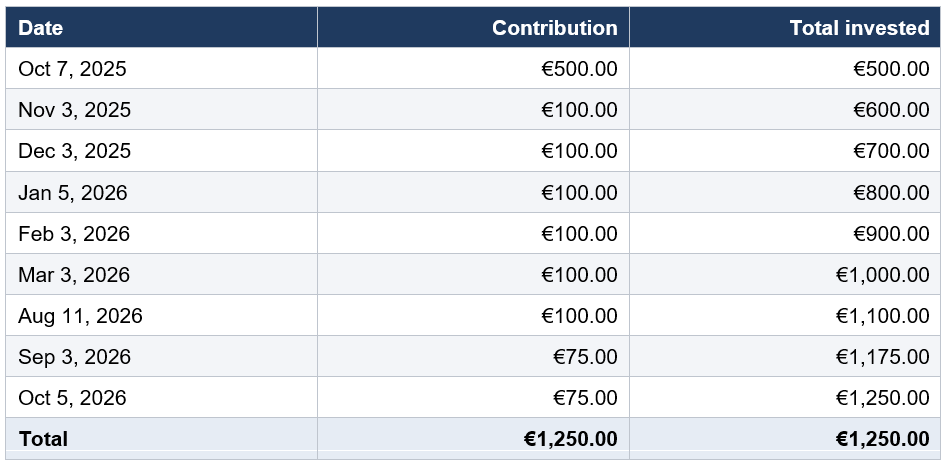
You will notice that this is not a perfect, uninterrupted schedule. I made no contributions between April and July 2026. To be completely honest, real life simply got in the way of my spreadsheets. Unexpected expenses popped up, forcing me to shift my immediate financial priorities. I simply didn’t have the spare cash to allocate during those months.
I know those loud financial gurus on social media preach about flawless, uninterrupted consistency. However, real-world personal finance rarely follows a perfect line. I would rather show you my actual, imperfect human journey with its real breaks than present a fake, sanitized version of investing for the sake of views.
After this brief pause, I restarted with €100 in August. I then dynamic-adjusted to €75 per month in September and October. This is an amount I can currently sustain comfortably without straining my daily cash flow.
The result after one year:
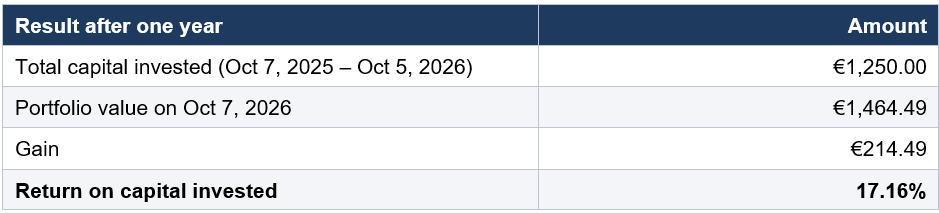
With a total of €1,250 invested, my portfolio was worth €1,464.49 on October 7, 2026. That unfiltered experiment yielded a gain of €214.49, or a highly rewarding 17.16% return on the total capital I contributed. For a simple, hands-off strategy, hitting a double-digit return right out of the gate felt incredibly validating, especially during a volatile economic year.
How to Read the 17.16% Figure Honestly
A number like 17.16% is easy to misinterpret. To avoid the typical hype you see online, here is what it actually means and what it does not.
- It is a return on capital invested, not an annualized return. I simply divided my total gain by the total amount I contributed. Because I contributed money at different times, most of my cash was not sitting in the market for a full year.
- Most of the gain came from my first deposit. My initial €500 was invested for the entire twelve months. This single move heavily carried the portfolio, representing 40% of everything I put in. My later contributions, particularly my late 2026 deposits, have had virtually no time to grow.
- It is a result measured strictly in euros. I invest from Europe, which adds a currency layer to the numbers. For a U.S. investor who earns and spends in dollars, the exact same index performance would look different due to fluctuating exchange-rate movements.
- It covers a tiny one-year window only. One year says very little about long-term wealth. Markets can, and absolutely will, pull back sharply at some point, and every serious investor must be mentally prepared for that volatility.
Where I Invested: Openbank and the Amundi S&P 500 Fund
The broker: Openbank
I made my investments through Openbank, a Spanish online bank. For context, it is a subsidiary of Banco Santander, which stands as one of the largest banking groups in Europe. Openbank operates fully online and offers a surprisingly clean brokerage platform with a wide catalog of investment funds. I chose it specifically because it let me invest in index funds from a single digital account. It allowed me to start with small amounts, which suited a gradual DCA plan perfectly without eating up my capital in high minimum fees.
The fund: Amundi S&P 500
The brokerage setup through Openbank was straightforward, offering a catalog of low-cost choices. The specific product I selected was the Amundi S&P 500 Screened Index Fund (ISIN: LU0996179007). Amundi is one of the largest asset managers in Europe, and this fund is designed to replicate the index performance with a minimal cost structure. I picked it because I prefer a transparent, hands-off strategy that follows the index over paying active managers who try and fail to outsmart the market.
Before choosing any fund, I recommend reading its official documents, especially the Key Information Document (KID or KIID), which lists its ongoing costs, risk indicator, and objectives. Costs vary between funds and can change, so relying on static articles like this one to track live fee updates is a dangerous way to plan your portfolio. You should always check the current figures yourself.
To be clear about my position, this article is not sponsored by Openbank, Amundi, or any other company mentioned. I am describing my personal experience, knowing that a strategy that fits my pocket might not make any sense for your unique financial situation, rather than recommending a specific product to anyone.

What I Learned in My First Year
1. Consistency matters more than the amount
My largest contribution was €500 and most were €100 or less. These are admittedly small numbers, but building the psychological habit is what truly counts. Starting small completely removed the common fear of “not having enough to invest.” Waiting for a massive windfall to start investing is a trap, and micro-contributions got my foot in the door.
2. Missing months is normal, but it has a cost
Pausing my contributions for four months meant that less of my money was putting in work during that time. When you look at charts showing historical market recoveries, you realize that sitting on cash during a bull run silently hurts your potential returns. If you can automate your investment so that it happens before you can spend the money, you are less likely to skip. I did not do that, leaving my portfolio vulnerable to my own daily spending choices, and I would do it differently next time.
3. Adjust the amount, not the plan
When I restarted, I lowered the amount instead of abandoning the strategy altogether. A smaller contribution that you can keep up comfortably is better than setting an aggressive, ambitious goal that forces you to give up when things get tight. Portfolio longevity is about survival, not winning a race in your first twelve months.
4. Ignore the noise
Daily headlines, apocalyptic market forecasts, and social media predictions make it incredibly tempting to change course. The financial media machine thrives on panic, but giving in to that anxiety only triggers unnecessary trading fees. A boring plan that you follow rigidly always beats an exciting, hyperactive strategy that you keep changing every time the market dips.
Investing in the S&P 500 From the United States
If you live in the United States, your practical route to the market is different from mine. Funds like the one I used, which are structured under European UCITS rules, are generally not offered to U.S. retail investors. Instead, smart U.S. investors typically use liquid S&P 500 ETFs like VOO, IVV, or SPY, which track the exact same underlying index and are available through virtually any U.S. brokerage. Many modern platforms also offer fractional shares, enabling you to automate small fixed amounts without needing the full price of a single share, exactly as a strict DCA plan requires.
In the U.S., you can also leverage tax-advantaged accounts, such as an employer-sponsored 401(k) as I said before or a traditional/Roth IRA, to shelter your long-term compounding growth from immediate capital gains hits. Annual contribution limits and tax rules change constantly, meaning that relying on generic internet advice instead of cross-referencing your strategy with the IRS or a qualified professional can lead to costly penalty traps.

Risks You Should Understand Before Investing
- Market risk. The S&P 500 can plunge by 20%, 30%, or more during historical bear markets, brutally testing your patience as it can take years to recover. You can lose substantial amounts of money, especially over short periods when volatility spikes.
- Concentration risk. Because the index is weighted by market capitalization, a significant part of your portfolio depends on a relatively small cluster of tech giants. Believing that owning 500 companies means owning 500 equal bets is a dangerous illusion, since a downturn in Silicon Valley will drag your entire investment down.
- Currency risk. If the currency of your selected fund differs from the currency you live in, exchange-rate changes will affect your results. A strengthening dollar or euro can quietly erase your stock gains or amplify your losses without you realizing it.
- Behavioral risk. The biggest danger for most long-term investors is their own psychology, specifically selling in a panic or chasing hyped recent winners. A boring DCA plan only works if you can successfully conquer your emotions and stick to it during a market crash.
- Past performance risk. Historical index returns, including my lucky first-year numbers, do not predict future market outcomes. Treating past data as a crystal ball is the easiest way to miscalculate your actual risk tolerance.
Frequently Asked Questions
Is dollar-cost averaging a good strategy for beginners?
For many beginners, absolutely, and my own experiment is proof of how it keeps you grounded. It makes investing highly manageable and completely reduces the daily psychological stress of trying to time a perfect entry point. However, as my portfolio shows, DCA does not eliminate risk or guarantee a profit. It operates best as I did, alongside a solid emergency fund and a long time horizon.
How much money do I need to start investing in the S&P 500?
Far less than most people think. Many brokers and modern investing platforms allow you to start with small amounts or fractional shares. In my case, I started with €500 and then used contributions of €100 or less. The right amount is simply whatever you can invest regularly without inducing financial anxiety or affecting your essential expenses.
Does a 17.16% return mean the S&P 500 returned 17.16% this year?
No, and misinterpreting this is a common rookie mistake. My 17.16% is the personal gain on the specific capital I contributed on specific dates, measured in euros. It is not the official return of the index over a calendar year, and treating it as a benchmark for the market’s overall health should be avoided.
Should I invest a lump sum or use DCA?
If you already have a large sum and a long time horizon, historical data suggests that investing it all at once has often produced better results, though it exposes your portfolio to the psychological pain of poor timing. Since I was investing from my ongoing savings, DCA was the only natural approach for my pocket. Ultimately, you should choose the method you can follow with unshakable discipline when markets get rough.
Can I lose money investing in the S&P 500?
Yes, unquestionably. The value of your investment can fall, sometimes brutally and sharply. Even though my first year ended with a €214.49 gain, the stock market does not owe anyone a profit. Only invest money you will absolutely not need in the short term, and make sure you understand the risks before you start.
The Bottom Line
To be completely fair, my first year with the S&P 500 was a massive success on paper, leaving me with €1,464.49 from my €1,250 total contributions. But I am absolutely not letting that 17.16% return go to my head. I know I simply got lucky with my entry date, and I fully expect to face brutal, red-dominated months down the road when market cycles inevitably shift. Real life frequently got in the way of my spreadsheet consistency, but that unpredictability is exactly why I chose a regular DCA schedule to act as my financial safety net.
What I value most isn’t this initial green spike in my portfolio account. It is that I built a boring, solid financial routine that works beautifully without needing any special stock-picking skills or constant market monitoring. My plan is to stick rigidly to the process, ignore the short-term media noise, and report my results again next year, whether the numbers are good or bad.
Disclaimer
This article is for educational and informational purposes only. It is not financial, investment, tax or legal advice, and it is not a recommendation to buy or sell any security or fund. The results described are my own personal results over a specific period, are calculated on the capital I contributed, and are not guaranteed to be repeated. All investments carry risk, including the possible loss of the capital invested. Past performance does not guarantee future results. Figures can change, so verify all data with official sources, and consider consulting a qualified financial professional before making investment decisions.
Sources and Further Reading
- S&P Dow Jones Indices – S&P 500® Overview: Leading Indicator of U.S. Equities and Main Benchmark for the U.S. Stock Market.
- S&P Dow Jones Indices – S&P U.S. Indices Methodology
- FINRA.org – The Benefits and Limitations of Dollar-Cost Averaging
- IRS.gov – 401(k) Plans
- Openbank – Online Banking. Grupo Santander
- Openbank – Amundi S&P 500 Screened INDEX AE Acc – LU0996179007
Written by L.Gomez · Last updated: October 23, 2026