

Knowing how companies get added to the S&P 500 helps explain some of the biggest one-day moves in the stock market. A company joins the index when a committee at S&P Dow Jones Indices selects it after it meets requirements for size, profitability, liquidity, float and trading history. The stock often moves because index funds that track the S&P 500 must buy it. This massive automated buying pressure highlights a clear market inefficiency: passive inflows frequently distort true asset valuations, creating artificial price spikes that active traders can exploit.
For a real portfolio example, read my comprehensive performance results after tracking the S&P 500 for a full year.
This guide explains the exact rules, how and when additions happen, why inclusion can move a stock’s price, and what it means for everyday investors. It also looks at why SpaceX, despite its enormous size, cannot join the index yet. The strategic takeaway is that navigating these regulatory barriers is vital to separating real macroeconomic fundamentals from pure retail market noise.
What Is the S&P 500, and Who Decides What Goes In?
The S&P 500 tracks about 500 large U.S. companies and is weighted by float-adjusted market capitalization, so bigger companies have more influence on the index. It is not simply a list of the 500 largest U.S. stocks. A committee at S&P Dow Jones Indices, a division of S&P Global, chooses the members, and it has discretion. A company can meet every rule and still be left out, in part because the committee also considers sector balance, meaning that no industry should be badly under- or over-represented compared with the broader market. This discretion confirms that inclusion is an active, human decision rather than a purely algorithmic selection. Consequently, the S&P Index Committee acts as the ultimate institutional gatekeeper. Their human decision introduces unpredictable regulatory risks that quantitative models often fail to price in.
The S&P 500 Eligibility Requirements
To be considered for addition, a company must meet all of the following criteria: S&P U.S. Indices Methodology
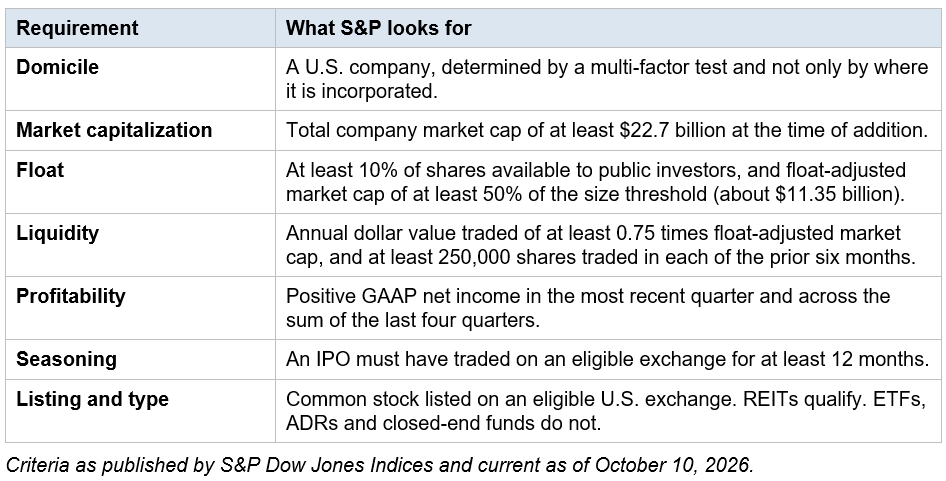
Two details matter. First, the $22.7 billion size threshold has been in place since July 2025, when it rose from $20.5 billion, and S&P revisits it periodically as the market grows. Second, the size requirement applies to additions only. A current member whose market value falls below the threshold is not automatically removed.
Meeting the rules also does not guarantee entry. In June 2025, shares of Robinhood and AppLovin surged on speculation that they would join, then fell when S&P announced no changes at its quarterly rebalance. Both were added in September 2025. This price volatility underscores a recurring phenomenon on Wall Street: retail investors frequently suffer from buying into unconfirmed index inclusion rumors. Front-running the S&P Index Committee is a highly speculative strategy, as the final decision remains entirely dependent on arbitrary institutional timing.
How and When Additions Happen
There are two main paths into the index:
- The quarterly rebalance. S&P reviews the index four times a year. Changes are typically announced after the market closes on a Friday early in March, June, September or December and take effect after the close on the third Friday of that month, which gives the market about two weeks of notice. This systematic two-week implementation window is critical, as it triggers intense institutional arbitrage while passive trackers re-align their asset weights.
- Ad hoc changes. When a member is acquired, merges or is delisted, S&P can add a replacement at any time. Interactive Brokers, for example, joined in August 2025, outside a regular rebalance to quickly fill an unexpected vacancy
Companies can also leave the index when they are acquired, shrink dramatically or stop meeting the criteria. S&P says that a company stays unless “ongoing conditions warrant an index change,” so removals are usually driven by clear deterioration, not a small slip below the size threshold. This asymmetric policy provides existing members a structural cushion, ensuring that index turnover remains low and transaction costs are kept to a minimum for passive funds.
Why Being Added to the S&P 500 Moves a Stock
Inclusion can move a stock for four reasons:
- Forced buying. Trillions of dollars are invested in funds that track the S&P 500. Because these trackers maintain strict portfolio duplication, funds hold each member in proportion to its index weight, so they buy the new stock, usually at the close on the effective date. This mechanism triggers massive mechanical inflows, meaning that demand arrives regardless of price.
- Visibility and liquidity. Membership brings analyst coverage, media attention and heavier trading volume. This enhanced institutional ecosystem is vital because it can make the shares easier to buy and sell.
- A credibility signal. Being added signals that a company is large, profitable and established. This corporate validation acts as an external quality screen, which automatically can attract investors who rely on those screens.
- Front-running. Traders try to buy right after the announcement and sell to index funds on the effective date. This short-term speculation often creates an artificial imbalance; it can push the price up quickly, and sometimes partly reverse it afterward once the passive rebalance concludes.
Tesla is the best-known example. After S&P announced its addition in November 2020, the stock jumped roughly 8% the next trading day, and it kept climbing as massive arbitrage volume drove the price upward until it joined in December.
Removal works in reverse. Index funds sell the stock, creating intense forced selling pressure, so shares tend to come under pressure, though other factors such as an acquisition can offset that.

Does the S&P 500 Effect Still Work?
The “index effect” has weakened over time. Research has found that the average price boost from an addition shrank sharply over the decades, largely because highly sophisticated institutional traders now anticipate likely additions and buy before the announcement. Recent results are uneven: some new members rally strongly, and others rise and then give back gains. Treat any single example as an anecdote, not a rule.
What This Means for Investors
- If you own an S&P 500 index fund, you do not need to do anything. The fund buys new members and sells removed ones automatically, and the committee’s choices affect your holdings without any action on your part.
- Do not chase rumors. Guessing the next addition is speculation. The committee does not publish a candidate list, and the Robinhood and AppLovin episode shows that anticipation can reverse.
- Remember that inclusion looks backward. Companies are usually added after years of growth, so joining the index often operates as a lagging indicator of past success and it is absolutely not a guarantee of future returns.
- Watch the calendar. If you hold a stock that is a likely candidate, expect higher volatility around the announcement and effective dates.
Case Study: Why SpaceX Cannot Join the S&P 500 Yet
SpaceX began trading on Nasdaq on June 12, 2026, in the largest IPO in history. Because passive funds would have to buy a company of that size, S&P consulted the market in April on easing its rules for very large new listings, including a six-month seasoning period and waivers for the profitability and float requirements.
On June 4, 2026, S&P decided to make no changes to the S&P 500 criteria. It said exceptions should not be granted solely because of market capitalization, reaffirming that core indexing standards outweigh Wall Street’s immediate appetite for mega-cap exposure. As a result, a new IPO still needs 12 months of trading, positive GAAP earnings and enough public float. For SpaceX, the earliest the seasoning rule could be met is around June 2027, and only if the company also meets the profitability and other tests by then. Nasdaq took a different path in March 2026 and adopted a fast-entry rule for large new listings in the Nasdaq-100, which is a separate index with its own rules.

Frequently Asked Questions
Is the S&P 500 made up of the 500 largest U.S. companies?
Not exactly. Size is one requirement, but profitability, liquidity, float, listing history and committee judgment also matter, so some very large companies are not members.
How often does the S&P 500 change?
The index is reviewed quarterly, and additional changes happen whenever a member is acquired or delisted. In a typical year, a few dozen companies are added or removed.
Does joining the S&P 500 guarantee a stock will rise?
No. Inclusion can bring a short-term boost from forced index fund buying, but this institutional effect varies and can fade. Long-term performance still depends entirely on the company’s underlying business fundamentals.
Can a company be removed from the S&P 500?
Yes. Companies leave when they are acquired, shrink significantly or no longer fit the index. Falling slightly below the size threshold alone does not trigger removal.
The Bottom Line
Joining the S&P 500 is a mix of hard rules and committee judgment, and the resulting buying by index funds explains why additions can move stocks. For most investors, the practical lesson is simple: an S&P 500 fund handles these changes automatically, and trying to profit from the announcement is a highly speculative arbitrage strategy that has become increasingly crowded.
Disclaimer
This article is for informational and educational purposes only and is not personalized investment, financial, tax or legal advice. Nothing here is a recommendation or solicitation to buy or sell any security. All investing involves risk, including the possible loss of your entire investment, and past performance does not guarantee future results. Index rules and thresholds can change, and the information is current as of October 10, 2026. Before making any investment decision, do your own research and consider speaking with a licensed financial professional.
Sources and Data Notes
- S&P Dow Jones Indices: S&P U.S. Indices Methodology Technical Rulebook
- S&P Dow Jones Indices: Update to S&P Composite 1500 Market Cap Guidelines Announcement (July 1, 2025)
- S&P Dow Jones Indices: Interactive Brokers and Walgreens Index Rebalance Notification (August 25, 2025)
- State Street Investment Management: Mega-Cap IPOs and Index Consultation Implications Overview
- S&P Dow Jones Indices: Official Consultation Results on Treatment of MegaCap Companies (June 4, 2026)
- Yahoo Finance: SpaceX GAAP Profitability and S&P 500 Entry Timeline Analysis
Written by L.Gomez · Last updated: October 15, 2026