

Intuitive Machines is the company behind the first U.S. Moon landing since Apollo 17. That’s a great headline and a poor reason to buy a stock. As retail investors, we cannot trade on emotion; a historic milestone does not automatically equal a profitable business model. A lunar lander is now only one slice of a business that is pivoting toward long-term infrastructure, building satellites, running communications networks, and taking contracts from the Pentagon.
This guide covers what the company actually does, what its latest results show, and where the real risks sit. Every figure comes straight from a company filing, a company press release, or NASA, and each one is linked to the primary source so you can check it yourself and make an informed financial decision. To see how these fundamentals stack up against other public corporations in the expanding aerospace sector, read our comprehensive market overview on the best space stocks to buy now.
LUNR at a glance
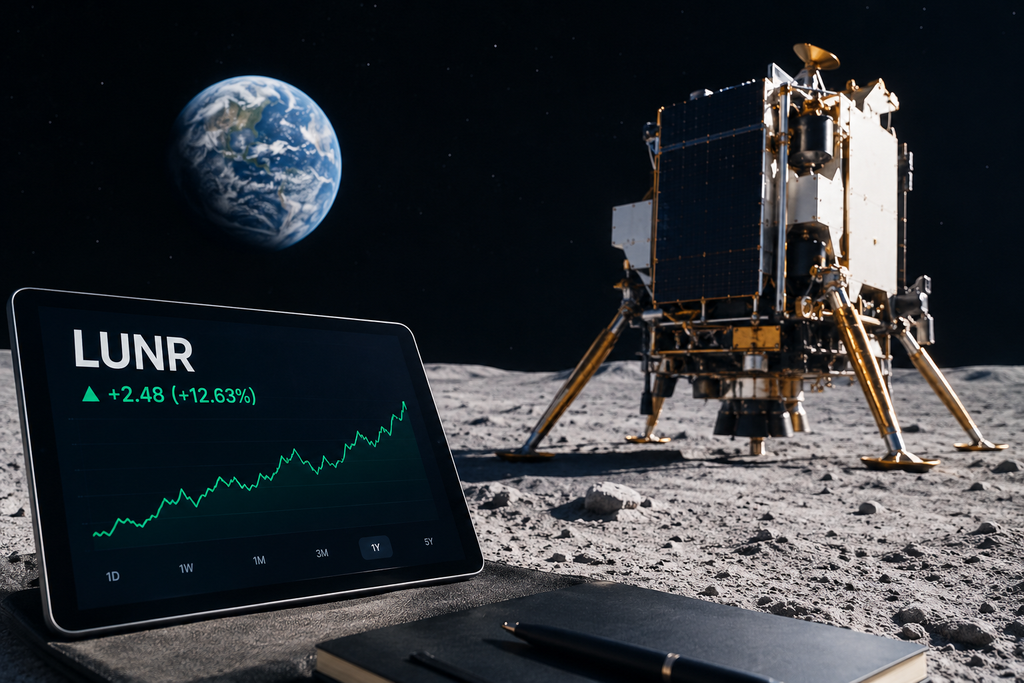
Before diving into the technical details, we need to anchor our analysis in hard numbers. Intuitive Machines’ financial profile shows a business experiencing explosive year-over-year revenue growth, backed by a massive contract backlog that promises long-term cash flow visibility. However, for new investors, the key will be monitoring how efficiently management converts this backlog into actual profit margins.
The following table summarizes the foundational metrics for LUNR as of its latest audited reports:
| Item | Figure | Source |
| Ticker and exchange | LUNR, Nasdaq (Class A common stock) | Merger announcement, Feb. 2023 |
| Q2 2026 revenue | $206.2 million | Q2 2026 results release |
| Backlog, June 30, 2026 | About $1.76 billion | Q2 2026 results release |
| Cash, June 30, 2026 | $367.4 million | Q2 2026 results release |
| 2026 revenue guidance | $900 million to $1 billion | Q2 2026 results release |
What Intuitive Machines actually does
According to its latest earnings release, the company describes itself as a space infrastructure business covering spacecraft manufacturing, communications networks, mission operations, and ground infrastructure. For anyone putting real money into this stock, however, the marketing jargon matters less than understanding the three specific segments driving their financial future.
Satellite manufacturing: This is the newest and arguably the most reliable piece of the business, built out through a strategic acquisition covered below that helps de-risk the company by moving away from a pure moon-landing play.
Lunar delivery: NASA’s Commercial Lunar Payload Services (CLPS) program pays private companies to carry cargo to the Moon. Intuitive Machines joined the CLPS vendor pool in 2018, per NASA’s CLPS Program Overview, and recently secured its sixth CLPS mission. This segment brings immense prestige, but as retail investors, we must treat these high-stakes missions as binary risk events that can trigger extreme stock volatility.
Data and communications: In September 2024, NASA awarded the company a Near Space Network contract to deploy lunar relay satellites and provide communication and navigation services. While the headline figure states a maximum potential value of $4.82 billion across a ten-year horizon, the initial award actually launched with incrementally funded task orders totaling $150 million. Smart money treats that multi-billion dollar figure as a strict budget ceiling rather than guaranteed cash flow, since future capital deployment depends entirely on meeting government milestones.

From a SPAC listing to two Moon landings
ntuitive Machines went public in February 2023 by merging with a blank-check company, Inflection Point Acquisition Corp., and began trading as LUNR on February 14. As many retail traders have learned the hard way, SPAC listings have a mixed record in the broader market. Because these structures historically dilute early shareholders, I treat that label as a reason to read the SEC corporate filings closely, not as a verdict.
The Moon missions came next. In February 2024, the Odysseus lander made the first U.S. lunar landing since Apollo 17 and the first by a commercial company. While IM-1 was a landmark success that proved their technology, the operational reality of space exploration remains unforgiving. Landing on the Moon is hard, and upcoming missions like IM-2 and IM-3 carry immense execution risk. A mission that ends early, experiences a hard landing, or loses communication can instantly rattle investor confidence and trigger heavy sell-offs, making this stock highly speculative for risk-averse portfolios.
The numbers: what the latest quarter shows
Revenue
Second-quarter revenue surged to $206.2 million from $50.3 million a year earlier, according to SEC-filed corporate reports. However, smart investors will notice that product revenue accounted for $166.7 million of this total—up from zero in the prior-year quarter—due to the January Lanteris purchase. In other words, much of this growth was bought, not built from scratch. That’s not a flaw, but it means organic growth isn’t as explosive as the headline suggests.
Losses
The company posted a net loss of $62.8 million for the quarter, driven by an operating loss of $47.1 million and a loss of $0.29 per Class A share. Even Adjusted EBITDA—a non-GAAP metric that strips out stock compensation and acquisition costs—came in at negative $13.8 million. Management is exposing itself to heavy scrutiny here, as they still anticipate a positive Adjusted EBITDA for the full year.
Cash and debt
Cash reserves stood at $367.4 million against $336.4 million in net long-term debt, while free cash flow plunged to negative $145.8 million for the first six months. This heavy cash burn means the company is effectively racing against its own capital runway to achieve profitability.
Guidance
Management expects 2026 revenue to land between $900 million and $1 billion. With first-half revenue at $392.9 million, the math dictates that the second half needs to generate roughly $507 million to $607 million. Achieving this will require a massive operational acceleration, given that the second quarter only brought in $206 million.
Backlog
The company’s backlog expanded to $1.76 billion from $213 million at the end of 2025, driven by $612.8 million from Lanteris and $1.34 billion in new awards. We must view this metric with caution: backlog is not cash in hand, but contracted work still to be delivered, meaning delays or government budget adjustments can shrink it instantly.
Share count
Weighted-average shares outstanding diluted to 162.2 million from 117.4 million a year earlier, largely due to $238.8 million raised through new security issuances. This dilution is a critical red flag for new buyers; your equity slice gets progressively thinner unless profits grow fast enough to offset the new supply of shares.
The Lanteris deal changed the company
On January 13, 2026, Intuitive Machines closed its purchase of Lanteris Space Systems, formerly Maxar Space Systems, for $800 million before closing adjustments, split between $450 million in cash and $350 million in stock. Lanteris builds satellites for missile warning and tracking, intelligence, Earth observation, and space domain awareness.
This acquisition was a defining moment for the company’s financial structure. The effect shows up clearly in the customer mix. National security surged from just 3% of revenue to 30% year over year in the second quarter, leveraging key government wins like a July award for 18 spacecraft for the Golden Dome missile-defense constellation. The commercial side also gained immediate traction with a contract worth more than $600 million for three commercial geostationary satellites, per the Q2 Earnings Release.
This shift represents a deliberate pivot from a high-risk Moon-lander startup toward a diversified small space prime contractor. While a broader portfolio naturally dilutes the binary risk of lunar missions, managing this transition introduces an entirely new layer of execution risk for the leadership team.
What could push the stock higher
- Backlog execution: The stock will likely respond well if the company turns its massive backlog into revenue on schedule. As investors, we need to track this closely in the upcoming quarterly updates on the Investor Relations Website.
- The lunar relay network: The first relay satellite, Altus-1, is planned to launch alongside the IM-3 mission in the first quarter of 2027, according to executive commentary on the Q2 Earnings Call Audio. A successful deployment here would prove their commercial infrastructure model works.
- Defense demand: The pivot toward national security means programs like the Golden Dome constellation could trigger steady, high-margin spacecraft orders, giving the stock a more predictable revenue baseline than volatile moon missions.
- EBITDA verification: Hitting their guidance for positive Adjusted EBITDA by the end of the year is the critical milestone needed to prove to Wall Street that this business can actually be self-sustaining.
What could go wrong
Investing in LUNR requires a sober look at the structural bottlenecks that could derail the stock. For instance, the upcoming IM-3 mission is targeted for a January to March 2027 window on a SpaceX Falcon 9, according to management on their latest call. This timeline depends heavily on spacecraft readiness, meaning any launch delay or another rough landing would severely damage market confidence.
This operational stress is compounded by a heavy cash burn and a rising share count. The six-month cash drain indicates the company may need to issue more shares, diluting current investors to survive. In fact, the company’s own risk language explicitly warns about their dependence on U.S. government contracts and customer concentration. New buyers should verify these vulnerabilities by reviewing the full risk section in the latest SEC EDGAR filings.
Finally, the Lanteris deal introduces massive integration risk. Acquisition costs hit $7.9 million in the second quarter and $27.9 million for the half, per the Adjusted EBITDA reconciliation. Absorbing a large satellite manufacturer while launching lunar missions is an aggressive balancing act that could easily lead to execution errors by management.
How I’d approach LUNR as a beginner
As a retail investor, the most critical rule is to start with the filings, not the forums. Read the latest quarterly report and the annual report, then compare them with what management says on calls. Because aerospace stocks experience extreme volatility around mission dates, you should always check the live price on the Nasdaq LUNR Stock Quote Page or in your brokerage app, since a static guide like this cannot keep up with a moving market.
Given the speculative nature of this sector, it is vital to keep the position small. A stock with this much event risk is better suited to a minority slice of a portfolio, next to a broad index fund, than to the core of one. My philosophy here is to only use money you won’t need for years, and don’t build a position all at once. Whether LUNR fits your personal strategy depends entirely on your financial goals and risk tolerance.
Once invested, your ongoing due diligence should track three distinct things each quarter: the IM-3 mission schedule, how fast backlog converts to revenue compared with corporate guidance, and the relationship between cash burn and share count dilution.

Frequently asked questions
Is Intuitive Machines profitable?
Not yet on a GAAP basis. The company is still heavily burning cash, reporting a net loss of $62.8 million in the second quarter. Management currently guides to positive Adjusted EBITDA for 2026 only, per its results release, meaning real bottom-line profitability remains a long-term goal.
Does SpaceX own Intuitive Machines?
No. SpaceX is the launch provider, not the parent company. It is crucial not to confuse operational partnerships with equity ownership; the IM-3 mission page simply lists a SpaceX Falcon 9 as the launch vehicle.
When is the next Moon mission?
The next major catalyst is the IM-3 mission, aimed at the Reiner Gamma region and currently targeted for early 2027. Because spaceflight timelines change constantly due to technical or weather variables, investors must check the company’s Investor Events Page for real-time updates.
The Bottom Line
Intuitive Machines is no longer just a speculative bet on lunar flags and headlines; the Lanteris acquisition turns it into a legitimate defense and satellite player. However, the explosive revenue growth comes with severe equity dilution and a heavy cash burn that new investors cannot ignore. If you decide to buy LUNR, treat it as a high-risk satellite allocation rather than a core portfolio holding, and keep your position small enough to stomach the inevitable volatility of its upcoming space missions.
Disclaimer:
This article is for educational purposes only and is not financial, investment, tax or legal advice. Investing involves risk, including the loss of your entire investment. Figures reflect company reports available as of October 23, 2026 and may change with later filings. Do your own research or consult a licensed professional before making decisions.
Sources
- NASA.gov — NASA, Intuitive Machines Share Images from the Moon, Provide Science Updates
- IntuitiveMachines.com — Intuitive Machines Investor Relations
- IntuitiveMachines.com — Intuitive Machines Reports Second Quarter 2026 Financial Results
- IntuitiveMachines.com — Intuitive Machines to Acquire Lanteris Space Systems
- NASA.gov — Commercial Lunar Payload Services
- IntuitiveMachines.com — Intuitive Machines Secures Sixth NASA CLPS Award
- NASA.gov — NASA Selects Lunar Relay Contractor for Near Space Network Services
- IntuitiveMachines.com — NASA Awards Intuitive Machines Near Space Network Contract Worth Up to $4.82 Billion
- IntuitiveMachines.com — Inflection Point Acquisition Corp. and Intuitive Machines, LLC Announce Completion of Business Combination
- IntuitiveMachines.com — SEC Filings | Intuitive Machines
- NASA.gov — CLPS Landing: Intuitive Machines (IM-1)
- IntuitiveMachines.com — Intuitive Machines IM-2 Lunar Lander Successfully Commissioned
- NASA.gov — Moon Base: Intuitive Machines IM-3
- SEC.gov — Intuitive Machines, Inc. (CIK 0001844452) EDGAR Browser
- IntuitiveMachines.com — Intuitive Machines Completes Acquisition of Lanteris Space Systems
- Nasdaq.com — Intuitive Machines, Inc. Class A Common Stock (LUNR)
Written by L.Gomez · Last updated: October 23, 2026