

Ask a room of investors whether Boeing is still a space stock and the answers will split. Some picture the aerospace titan that helped build the International Space Station and NASA’s Space Launch System. Others see a jet maker whose space ambitions, led by the troubled Starliner capsule, have mostly served to incinerate shareholder capital. Both views contain some truth. However, for anyone managing a portfolio, sentimentality doesn’t pay the bills.
To most people, Boeing is synonymous with commercial aviation. More recently, it is known for the compounding manufacturing scandals surrounding its 737 Max jets. However, the cultural and operational flaws plaguing its commercial airline division have clearly bled into its space program. What happens in orbit cannot be detached from Boeing’s broader corporate crisis.
This guide answers the question directly. It explains where Boeing still operates in space, what has happened to Starliner, and how much any of it matters to Boeing’s financial results. We will bypass the corporate public relations to look at the hard balance sheet impact. All figures are current as of October 12, 2026, and the sources are listed at the end.
Key Takeaways
- Boeing is still an active participant in space. However, space remains a small, unprofitable slice of a company stubbornly driven by commercial jets and defense contracts.
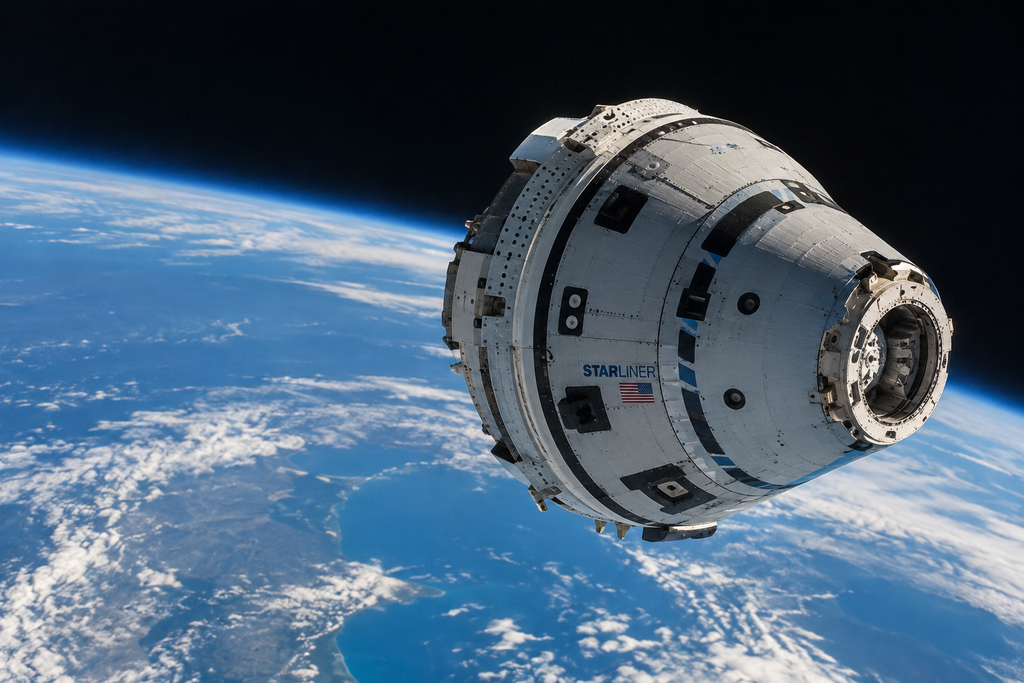
- Starliner has been delayed yet again. An uncrewed cargo flight is targeted for no earlier than December 2026. Meanwhile, the next crewed flight has been pushed back to mid-2028.
- Boeing absorbs every single dollar of cost overruns on Starliner. This is because its NASA contract is fixed-price. Reported losses on the program had reached a staggering $2 billion by February 2025.
- NASA has officially replaced Boeing’s planned Space Launch System upper stage with one built by United Launch Alliance. Boeing owns half of this joint venture. This clear strategic pivot directly dilutes Boeing’s standalone control.
- Boeing is a remarkably weak proxy for pure space exposure. If you own an S&P 500 index fund, you already own Boeing. Using it as a core space play is, frankly, an inefficient use of capital.
The Short Answer: Space Exposure, Not a Space Company
It is vital to understand that Boeing is a company with space exposure, not a space company. In the second quarter of 2026, it reported total revenue of $24.6 billion.
Its Defense, Space & Security segment clumsily combines space programs with fighter jets, tankers, helicopters, and missiles. This segment generated $7.5 billion of that total, or roughly 30 percent. Crucially, Boeing does not report space as its own line item in these headline results. This means the space share is only a minor fraction of that 30 percent.
The same segment posted a disappointing operating loss in the quarter. The segment’s operating margin was negative 0.2 percent. This loss was dragged down by $280 million of charges on the VC-25B presidential aircraft program. Meanwhile, Commercial Airplanes remains the undisputed engine of the stock. This division delivered 171 jets in the quarter.
In practice, commercial aircraft deliveries, free cash flow, and defense execution will drive Boeing’s share price. These core drivers matter far more than any single space milestone. For long-term investors, the space race at Boeing is secondary to the company’s structural turnaround on the tarmac.
Where Boeing Still Operates in Space
Boeing’s space footprint is still substantial in absolute terms. It simply sits inside a much larger business.
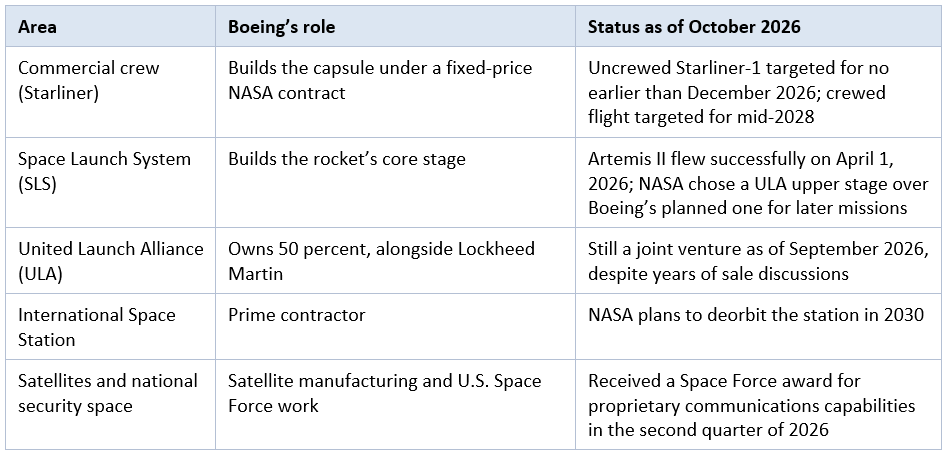
Looking closely at this breakdown, it’s clear that Boeing’s space portfolio is a mix of legacy defense moats and severe operational bottlenecks. While steady revenue from the U.S. Space Force and the SLS core stage provides a baseline cushion, the ticking clock on the ISS deorbit in 2030 and the multi-year delays on Starliner mean this segment faces a very steep uphill climb toward meaningful growth.
Starliner: How the Program Got Here
Starliner was originally engineered to make Boeing an equal, high-profile partner to SpaceX in flying NASA astronauts to orbit. Way back in 2014, NASA awarded fixed-price commercial crew contracts to both aerospace firms, with Boeing’s award valued at a massive $4.2 billion. While a nimble SpaceX began operational flights with astronauts in 2020, Starliner’s operational record looks very different and tells a cautionary tale for long-term investors:
- December 2019: The first uncrewed test flight suffered critical software errors that a NASA safety panel later admitted could have been catastrophic. As a result, the capsule failed to reach its target destination at the station.
- 2022: A repeat uncrewed test finally succeeded, but only after a previous 2021 launch attempt was abruptly scrubbed when propulsion valves stubbornly refused to open.
- June 2024: The first crewed flight carried NASA astronauts Butch Wilmore and Suni Williams. In what became a public relations disaster, five of the capsule’s 28 maneuvering thrusters failed on approach, and multiple helium leaks appeared. NASA ultimately judged the capsule unsafe for the return trip, forcing it to come home empty in September 2024. The astronauts returned on a SpaceX Crew Dragon after spending more than nine grueling months in orbit.
- November 2025: Facing mounting pressure, NASA and Boeing quietly cut the guaranteed number of flights from six down to just four, effectively downgrading Starliner-1 to a cargo-only mission.
- February 2026: NASA Administrator Jared Isaacman released an independent investigation report, officially classifying the 2024 flight as a Type-A mishap—the agency’s most serious category. The scathing report sharply criticized NASA’s own systemic oversight deficiencies alongside the program’s fundamental engineering failures.
The September 28, 2026 Update
On September 28, NASA and Boeing unexpectedly recommitted to the program. For anyone tracking the stock, these are the critical takeaways to note:
- Starliner-1, still uncrewed, is targeted for no earlier than December 2026. Starliner-2—the next flight with actual astronauts—is targeted for mid-2028, with NASA astronaut Woody Hoburg named as commander.
- The long operational gap exists because a deeply rooted mechanical flaw in the thruster valve parts simply cannot be fixed with the current design. While Boeing has added temporary thermal protection, a complete engineering redesign will take time and must be thoroughly tested before any crewed missions get the green light.
- NASA agreed to a $359 million contract modification to cover some of the immediate cost of returning to flight, while also moving to restore the two flights previously cut in 2025. This provides Boeing with a minor financial lifeline, but it doesn’t erase the broader program deficit.
- Only six Atlas V rockets remain on the market, and all of them are strictly reserved for Starliner. Moving forward, NASA will help certify Boeing’s capsule to fly on ULA’s newer Vulcan rocket infrastructure.
- NASA’s reasoning here is entirely strategic. The agency is desperate to maintain two independent crew providers, especially since SpaceX plans to eventually retire Crew Dragon as it transitions toward Starship. However, whether Starliner has any viable commercial market after the space station is deorbited in 2030 remains highly questionable, particularly since NASA’s plans for commercial replacement stations are completely unsettled.

What Starliner Costs Boeing Shareholders
Because the contract is fixed-price, Boeing is solely on the hook for every single dollar of overruns. Reported losses reached roughly $2 billion by February 2025, and the compounding delays since then suggest that total has quietly grown. While that is an eye-watering figure, smart investors recognize it mostly as a sunk cost distributed over multiple fiscal years, making it relatively small next to Boeing’s massive overall scale.
For context, the company ended the second quarter of 2026 with a staggering, record-breaking total backlog of $715 billion, which includes $85 billion parked at Defense, Space & Security.
The more important point for your portfolio is that Starliner’s future revenue potential is also remarkably small. Even if they successfully execute those four to six planned NASA flights, the program is simply unlikely to ever become a major profit center. Instead, its true significance is almost entirely reputational and strategic; it serves as a live operational test case of whether Boeing’s engineering can actually deliver a complex, safety-critical program under a fixed-price model. Investors who worry about Boeing’s execution on fixed-price contracts will find the concurrent $280 million VC-25B presidential aircraft charges in the exact same quarter just as relevant as anything happening up in space.

Other Pressures on Boeing’s Space Business
Starliner is far from the only operational challenge clouding Boeing’s space portfolio:
- SLS upper stage: In March 2026, NASA selected ULA’s Centaur V upper stage for the SLS starting with the Artemis IV mission, abruptly dropping Boeing’s long-delayed Exploration Upper Stage (EUS). While Boeing still builds the core stage, losing this high-value component represents a major blow to its future deep-space revenue pipeline.
- ULA’s finances: Vulcan faced a strict government review due to a solid rocket motor anomaly before finally being cleared in April 2026 to resume vital national security launches. Underscoring these underlying systemic risks, Boeing and Lockheed Martin were reported to have each guaranteed up to $500 million of ULA credit facilities back in May 2026 to shore up the joint venture’s liquidity.
- A partial offset: ULA’s new SLS upper stage contract adds recurring deep-space work, and Boeing owns half of it. However, this consolidation means the financial upside must be split down the middle with Lockheed Martin.
The Bull and Bear Cases for Space-Minded Investors
The bull case
- NASA has firmly reaffirmed its commitment to Starliner, and executing a completely clean Starliner-1 flight would finally remove a major, years-long reputational overhang clogging the stock’s valuation.
- Boeing’s commercial aviation recovery remains the primary driver for the equity, highlighted by record jet deliveries and positive free cash flow reported in the second quarter. For value investors, the core turnaround story is what actually matters.
- Its 50% stake in ULA, its steady SLS core stage manufacturing work, and its reliable Space Force contracts give Boeing a highly diversified defense exposure, ensuring the division doesn’t suffer from a single point of failure. This established footprint provides a defensive floor that pure-play space startups simply cannot match.
The bear case
- Starliner has missed nearly every single milestone since 2019, making further technical setbacks highly probable. This chronic execution track record makes it impossible for investors to model reliable future cash flows.
- The structurally flawed fixed-price contracts in defense and space have repeatedly produced surprise charges that wipe out entire quarters of profit.
- Losing the SLS upper stage and dealing with ULA’s financial strain prove that space is currently a capital drain rather than a growth engine inside Boeing.

Boeing Versus Pure-Play Space Stocks
Pure-play companies such as Rocket Lab or AST SpaceMobile earn most or all of their revenue from space and trade at premium multiples driven largely on growth expectations. In stark contrast, Boeing trades almost entirely on commercial aircraft deliveries, cash generation, and defense execution. If your goal is concentrated exposure to the space economy, holding Boeing dilutes it heavily. If your goal is a large, established aerospace company with a space option attached, it fits better. These are fundamentally different investments with entirely different risk-reward profiles, and one should never be treated as a substitute for the other.
Boeing in an S&P 500 Index Portfolio
Boeing is a member of the S&P 500, along with defense and aerospace peers such as Lockheed Martin and Northrop Grumman. Consequently, an investor who holds a broad, market cap-weighted S&P 500 index fund already owns a small slice of Boeing’s space business, though Boeing’s weight in the index currently sits at just a fraction of one percent. Buying additional Boeing shares for space exposure would simply add a concentrated bet on a single company’s highly volatile operational turnaround, rather than offering a diversified play on the space economy as a whole.
What to Watch Next
- Starliner-1: The December 2026 target is the first real operational test of the thermal fixes. In aerospace, timeline slips are common, so treat this date strictly as an estimate.
- Third-quarter earnings: Boeing typically reports in late October. Investors should carefully watch the Defense, Space & Security margin and brace for any new program charges.
- ULA: Pay close attention to Vulcan’s launch pace, any decision on selling the joint venture, and the credit guarantees silently weighing on Boeing and Lockheed Martin.
- NASA contract actions: Formal restoration of the two cut Starliner flights and regulatory progress on certifying Starliner for the newer Vulcan rocket.
- Commercial space stations: NASA’s plans for replacing the ISS will ultimately determine whether Starliner has any viable customers after 2030.
Frequently Asked Questions
Is Boeing a good space stock to buy?
That depends entirely on your investment goals and risk tolerance, and this article cannot make that decision for you. The truth is that Boeing offers modest space exposure trapped inside a much larger commercial aerospace and defense business, meaning it is not a pure play. If you buy shares, you are betting more on a massive corporate turnaround on the ground than on the future of orbit. Review its financial filings carefully and consider how it fits your overall portfolio.
Is Starliner flying right now?
No. Starliner’s last flight was the 2024 crewed test that unfortunately ended with the capsule returning empty. The next mission, an uncrewed cargo flight to the International Space Station, is targeted for no earlier than December 2026. Until then, Boeing’s crewed operations remain firmly grounded.
Does Boeing own United Launch Alliance?
Boeing owns exactly half of ULA, and Lockheed Martin owns the other half. The two aerospace giants have explored selling the joint venture for years, but as of September 2026, no sale has materialized on Wall Street.
How much has Boeing lost on Starliner?
Reported losses on the program reached about $2 billion by February 2025. That total is undoubtedly higher today due to the compounding engineering delays since then, but Boeing has not published a single updated figure in its recent earnings reports.
The Bottom Line
Boeing is still a space stock only in a limited sense. It builds the SLS core stage, owns half of ULA, serves as prime contractor on the space station, and is working to return Starliner to flight. But space remains a minor and troubled part of a business that ultimately lives and dies on commercial jet deliveries and defense execution. For most investors, Boeing’s space exposure is merely a footnote to its core investment thesis. Investors who want direct, unadulterated exposure to space should look well beyond Boeing, and those who already own an S&P 500 index fund already hold all the exposure they practically need.
Disclaimer
This article is for educational purposes only and is not personalized financial, legal, or tax advice. Investing involves risk, including the possible loss of principal, and past performance does not guarantee future results. Figures are accurate as of the date shown and may change. Verify current information with company filings and NASA before making any decision.
Sources
- Space.com – Boeing’s Starliner Won’t Launch Astronauts Until 2028 (And May Need a New Rocket), NASA Says: Propulsion Redesign and Vulcan Transition
- SpacePolicyOnline.com – Next Crewed Boeing Starliner Flight Not Until 2028: NASA and Boeing Program Recommitment and Schedule Updates
- SpacePolicyOnline.com – Boeing’s Starliner Losses Reach $2 Billion: Fixed-Price Financial Overruns and Program Technical Challenges
- Spaceflight Now – NASA Contract Confirms Selection of ULA’s Centaur 5 as New Upper Stage for the SLS Rocket: Artemis IV Implementation and Procurement Details
- Boeing – Q2 2026 Earnings Release: Second Quarter Financial Results and Backlog
- Yahoo Finance – Boeing’s Recovery Momentum Surges With $24.6B Revenue in Q2: Aircraft Deliveries and Production Line Expansion Updates
- Boeing – Q2 2026 Financial Results: Second Quarter Press Release and Summary Operations Tables
- SpacePolicyOnline.com – NASA Safety Panel Wonders If Boeing Can Meet Starliner Schedule: Fixed-Price Contract Framework and Safety Recommendations
- Spaceflight Now – NASA, Boeing Pivot Starliner-1 Mission From 4-Person Astronaut Flight to Cargo-Only: Commercial Crew Program Schedule Changes
Written by L.Gomez · Last updated: October 18, 2026